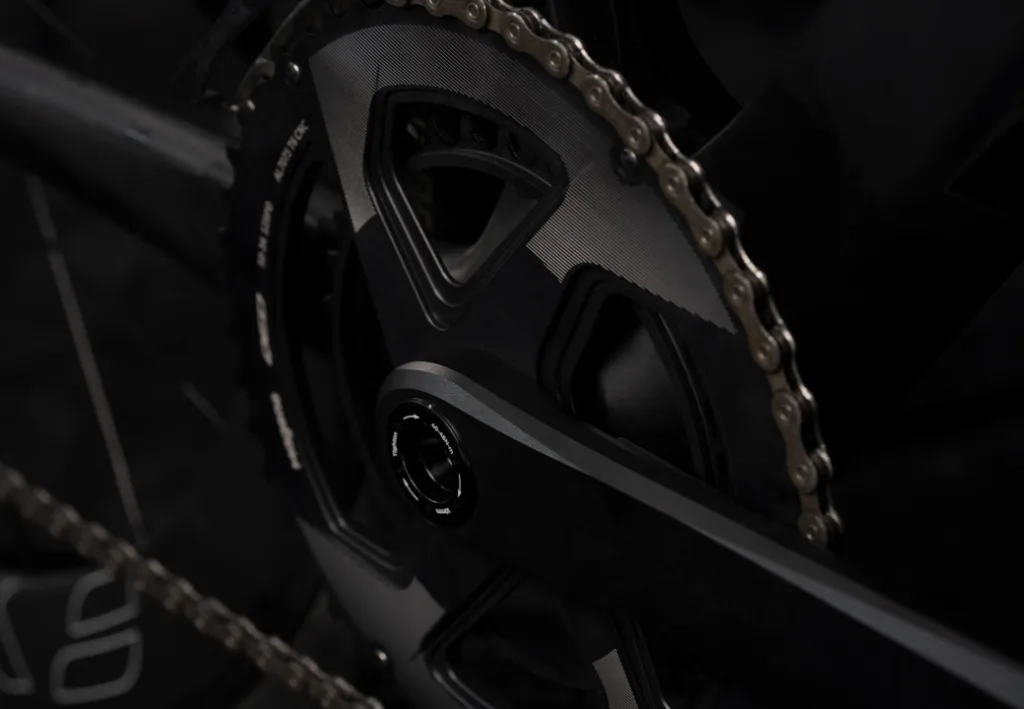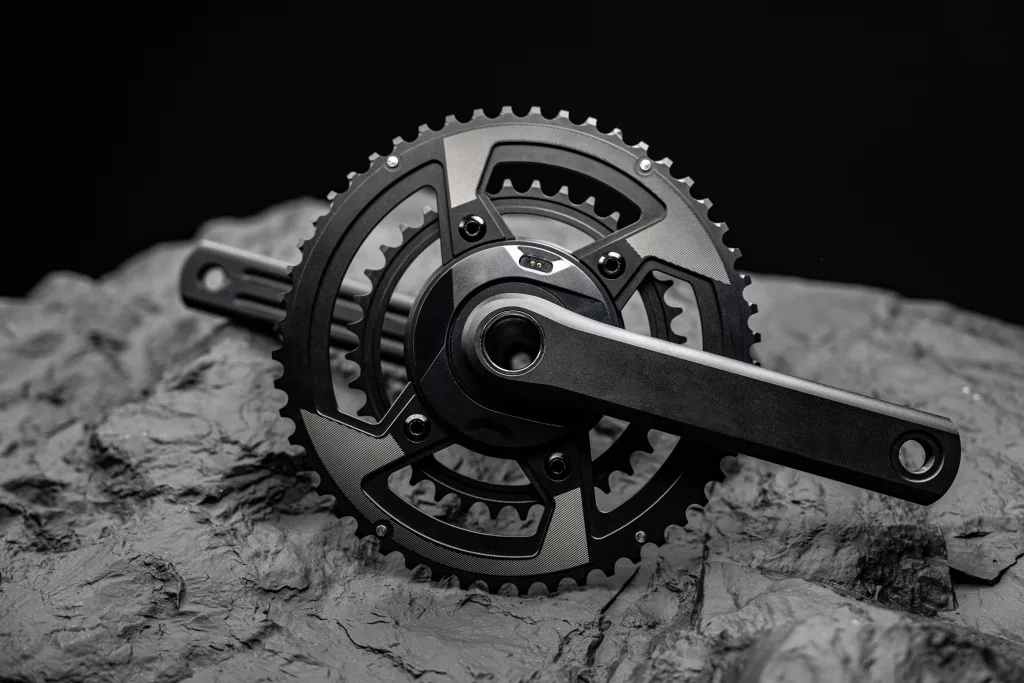

bike power meter is a precision cycling sensor that measures a rider’s power output in watts. It can be used to analyse riding intensity, efficiency, training load and performance. However, during steady indoor riding, most power meters seem to work normally. The differences often appear in later rides, such as during sprints, after the temperature drops, or when the power meter is installed on a different crankset.
Most power meter brands claim ±1% measurement accuracy, but this does not tell you whether the power meter is suitable for your needs or guarantee that it can provide the data you require. Therefore, before choosing one, it is helpful to understand the measurement location and the factors that can affect accuracy.
How does a power meter measure power?
The measurement logic of a bike power meter is very simple. Strain gauges are installed inside the pedals, crank arms or crank spider. Pedalling force causes these components to bend slightly. The strain gauges detect this change, and the electronic system uses it to calculate torque. Power in watts is then calculated using torque and rotational speed. Finally, the power meter transmits the data to a bike computer, smartwatch or training application through ANT+ or Bluetooth.
Power responds faster than heart rate. If a rider stands out of the saddle while climbing, the change in effort appears almost immediately. This makes a cycling power meter very useful for pacing, interval training and comparing long-term training results.
Common types of power meters
Common types of power meters include pedal, crank-arm and spider power meters. Each has its own suitable applications. The best choice depends less on the sensor location itself and more on the bicycle, the rider and how often the system needs to be moved.
| Type | Measurement point | Main advantage | Main limitation | Typical use |
|---|---|---|---|---|
| Pedal-based | Pedal spindle | Easy to move between bikes | Cleat and pedal compatibility | Riders using several bikes |
| Crank-arm | One or both crank arms | Low added weight and accessible cost | Limited to compatible cranks | Training on one main bike |
| Spider-based | Between the crank and chainrings | Integrated total-power measurement | Requires drivetrain compatibility | Dedicated bikes and factory installation |
Pedal power meters
A pedal power meter installs sensors inside one or both pedal spindles. For riders who own several bicycles, this is usually the easiest system to transfer between bikes. In most cases, only the pedals need to be replaced, without changing any drivetrain components.
True dual-sided models can measure the power of the left and right legs independently. This may be helpful for riders or coaches who require professional monitoring.
However, pedal power meters also have disadvantages. The pedal thread and cleat system must match, while stack height and Q-factor may change the rider’s riding position. In addition, the pedals are directly exposed to road spray, mud and occasional impacts. For gravel or mountain bike riding, sealing and impact resistance deserve the same attention as the accuracy data.
Crank-arm power meters
Crank-arm systems install strain gauges on one or both crank arms. Many affordable versions measure only the power of the non-drive-side leg and multiply the result by two. For non-professional riders who want consistent training data on one bicycle, this is usually enough.
Crank power meters have more installation and fit requirements. For example, the crank model and length must match, and there must be enough clearance between the sensor and the frame. The compatibility of the spindle and bottom bracket should also be checked.
A single-sided power meter has another limitation. It usually assumes that each crank arm contributes half of the total power. If the rider’s balance changes during high-intensity riding, the estimated total power may shift even if the power meter itself has no fault.
Spider power meters
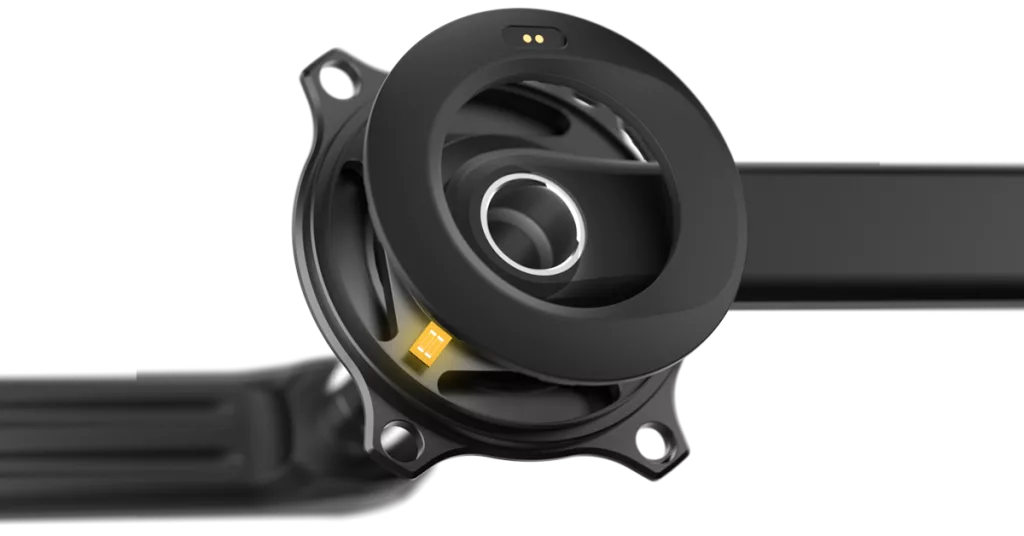
A spider power meter is installed between the crank and the chainrings. Because both legs transfer force through the spider, it normally measures the total power generated by both legs.
Spider power meters are well protected, and riders are free to choose suitable pedals. For performance bikes designed for racing, this design also creates a clean setup.
For bicycle brands, a spider-based design is highly suitable as original equipment. The power meter becomes part of the original bicycle specification rather than an aftermarket accessory.
However, installation still requires careful planning. The crank interface, BCD, chainring arrangement, chainline and frame clearance are all important. Magene Enterprise provides spider power meter solutions for bicycle brands, including ODM services that support customised appearance and functional development.
What do “single-sided” and “dual-sided” mean?
A single-sided power meter measures the power of only one leg and doubles the reading. A true dual-sided power meter uses independent sensors to measure the power of the left and right sides separately.
Spider power meters usually measure the combined torque of both legs. Some spider systems estimate left-right balance by analysing different stages of the pedalling cycle, but this is not the same as using two independent sensors.
Most riders do not need every available metric. Stable total-power data is usually sufficient for FTP testing, pacing and training-zone management. Independent leg data is more useful when it is needed to support specific coaching, riding adjustment or rehabilitation goals.
What does power meter measurement accuracy mean?
Accuracy describes how close a reading is to a reference value, while fluctuations in accuracy describe whether the power meter performs consistently across different rides.
For training, a small and stable deviation is usually acceptable, but unpredictable fluctuations can affect your training. If a power meter reads slightly low every day, the rider can still track training progress. However, if the deviation keeps fluctuating with temperature or intensity, the reliability of data comparisons will decrease.
Steady indoor riding cannot fully test accuracy. Installation torque, zero offset, cadence, rapid acceleration, vibration, battery condition and firmware may all affect the reading. Temperature may also have an effect, especially when a ride begins indoors and then moves outside into a much colder environment.
A study about Shimano also includes factory temperature calibration as part of the power meter production process.
Before accepting any accuracy claim, first check the test conditions behind it. An effective test should include steady riding, low-cadence torque and short, high-intensity sprints.
Checking power me ter compatibility
To check power meter compatibility, first inspect the components already installed on the bicycle. Confirm the crank interface, spindle diameter, bottom bracket, BCD (chainring spacing) and chainring arrangement. Chainline, crank length, Q-factor and frame clearance should also be considered, as these may affect installation. Different generations of cranks from the same brand may use different mounting systems.
Next, consider connectivity. ANT+ is compatible with many bike computers and can transmit data to several compatible devices. Bluetooth is widely supported by mobile phones, tablets and indoor cycling applications, but connection limits vary between brands.
Therefore, confirm whether the power meter supports your bike computer and application. Make sure firmware updates are easy to complete. If the rider plans to connect a bike computer and an indoor training platform at the same time, confirm in advance whether the power meter supports this function.
Finally, battery design is very important for the rider’s daily use. Rechargeable devices require an easily accessible charging cable, while replaceable batteries introduce an additional waterproofing risk. The waterproof rating, calibration steps, spare parts and warranty service should be carefully reviewed before purchase.
Factors bicycle brands need to consider
Bicycle brands are completely different from individual riders. A rider only needs to choose one power meter device, but a bicycle brand must ensure that the power meter works properly across its own model range.
This requires bicycle brands to conduct sample testing, physical fit checks and develop a documented assembly process. None of the data or steps should depend on guesswork at the production station. Brands must also confirm that readings remain consistent between different production batches. Firmware support, waterproof performance, spare-parts supply and after-sales responsibilities should be confirmed with the partner brand in advance.
The partner brand’s supply capacity is equally important. A component that works properly during development must still have sufficient supply when production volume increases.
A power meter-ready bicycle should provide reliable data during its first test. Compatibility problems that could have been avoided should not be discovered only after delivery.
For the factors that bicycle brands need to consider, Magene Enterprise provides very detailed cycling solution planning, including sample testing and factory integration services. Product teams can also request a power meter compatibility assessment before entering mass production.
Summary
When choosing a bike power meter, attention should be paid to its measurement principle, actual riding performance and compatibility with the complete bicycle. Riders may pay more attention to price or portability. Bicycle brands must also plan the assembly process in advance, ensure production consistency and provide after-sales support following launch.
FAQ
Which type of bike power meter is the most accurate?
No sensor location is naturally the most accurate. Design, calibration, temperature compensation, installation method and test conditions all affect the measurement results.
Is a single-sided power meter accurate enough?
It can provide stable training data. However, it estimates total power by multiplying the single-sided power value by two, so changes in the power contribution ratio between the left and right legs may affect the reading.
Is a spider power meter dual-sided?
A spider power meter usually measures combined total power. Its estimated left-right balance may not be the same as the results independently measured by two sensors.
How do I check power meter compatibility?
Confirm the crank interface, spindle, bottom bracket, BCD, chainrings, chainline and frame clearance. Then check ANT+, Bluetooth, firmware and bike-computer support.
Can a power meter connect to a bike computer and a mobile application at the same time?
Many models support both ANT+ and Bluetooth. The number of simultaneous Bluetooth connections varies by model, so check the product specifications first.