A bike power meter may claim ±1% accuracy, but that number is easy to misread. It does not mean every displayed watt is the rider’s exact mechanical output, nor does it guarantee that two power meters will show identical values.
The claim is meaningful only when the test method, reference system and operating conditions are understood. For riders, this helps explain why trusted devices can disagree. For bicycle brands, it defines what must be validated before a cycling power meter is approved for a complete-bike platform.
What Does ±1% Power Meter Accuracy Mean?
Accuracy describes how close a measurement is to an accepted reference value. If a reference system indicates 300 W, a power meter operating within ±1% should report between 297 W and 303 W under the conditions covered by its specification.
The allowable difference grows with power:
| Reference power | ±1% range |
|---|---|
| 100 W | 99-101 W |
| 250 W | 247.5-252.5 W |
| 300 W | 297-303 W |
| 1,000 W | 990-1,010 W |
This is normally a percentage of the reading, not a fixed one-watt tolerance. It should also be tied to a defined test range. A complete specification needs to state the relevant power, cadence, temperature and installation conditions.
If two devices each claim ±1%, they can still differ by as much as 2% relative to the same reference. At 300 W, one could read 297 W while the other reads 303 W. A six-watt gap is therefore possible before measurement location and drivetrain losses are considered.
Accuracy, Precision and Consistency Are Different
These terms are often treated as synonyms, but they answer different questions.
- Accuracy: How close is the result to a traceable reference?
- Precision or repeatability: How closely do repeated measurements agree under the same conditions?
- Reproducibility: Does the result remain comparable across units, test systems, environments and time?
- Consistency in use: Does the power meter provide stable data from ride to ride?
A meter can be repeatable but biased. For example, it may read 3% high every day. That data can still track an individual rider’s training trend, but it makes comparisons across bikes, devices or seasons less reliable. A strong power meter must control both bias and repeatability.
How a Cycling Power Meter Calculates Power
Mechanical cycling power is calculated from torque and angular velocity:
Power = Torque × Angular Velocity
Strain gauges detect deformation caused by pedalling force. The power meter combines that torque signal with cadence or angular-velocity data, processes the result and transmits it to a bike computer.
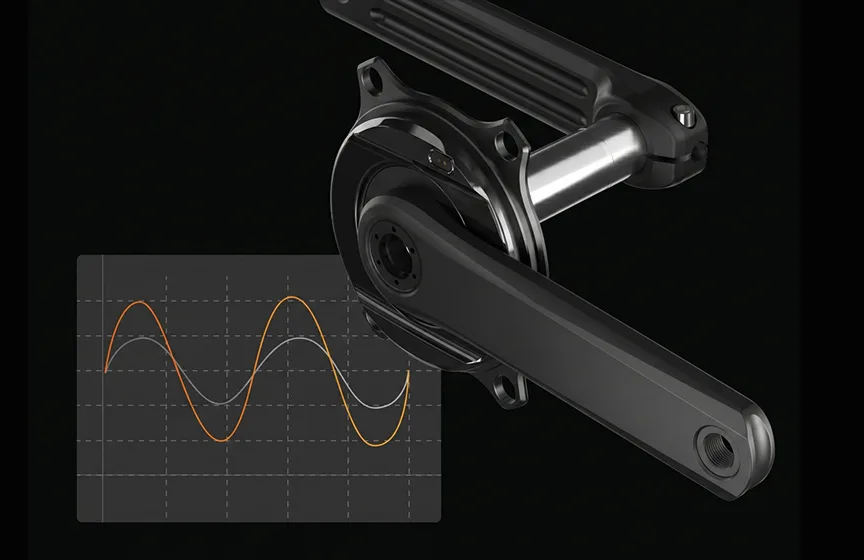
Real pedalling is not smooth. Torque and rotational speed change within every revolution, especially during sprints, steep climbs, low-cadence efforts or use with non-round chainrings. A laboratory test based only on constant rotation may therefore miss errors that appear during real riding.
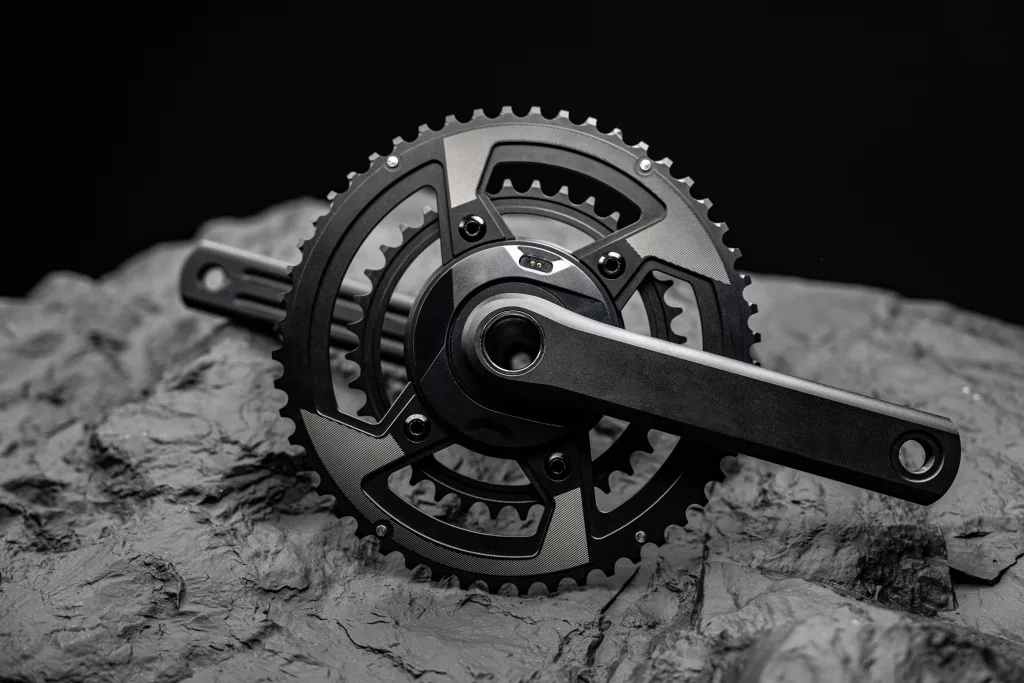
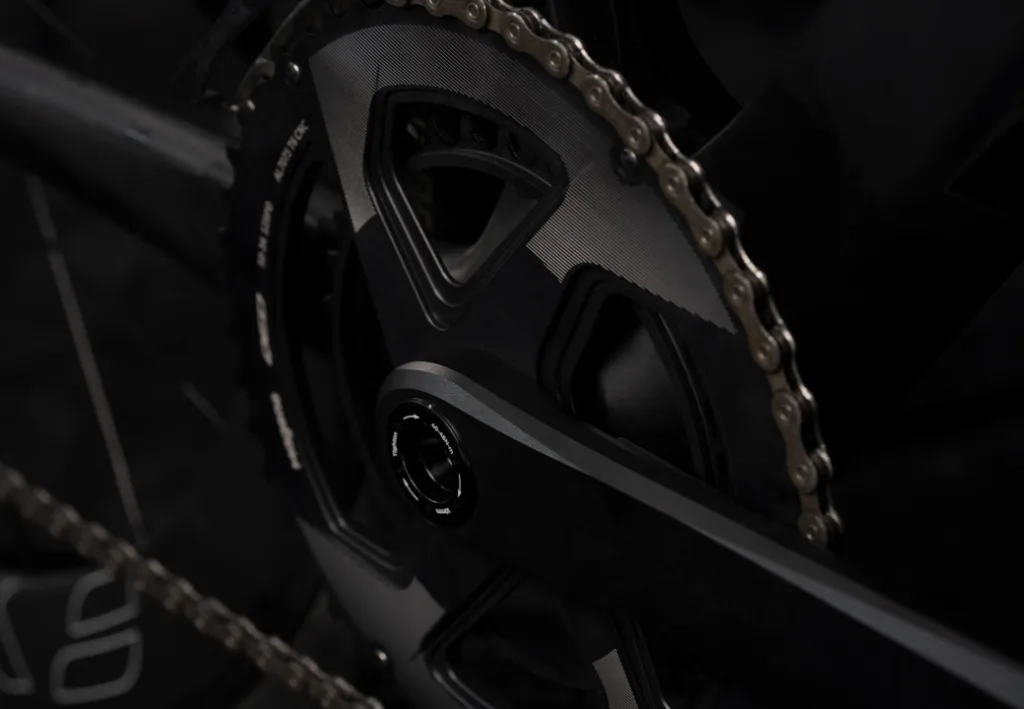
Sensor position matters as well. Pedal, crank, spider and hub systems do not measure at the same point in the drivetrain. A spider power meter captures combined output near the chainrings, while a crank power meter may measure one crank arm or a broader crankset structure. A smart trainer measures farther downstream, after energy has passed through the drivetrain.
How Power Meter Accuracy Is Tested
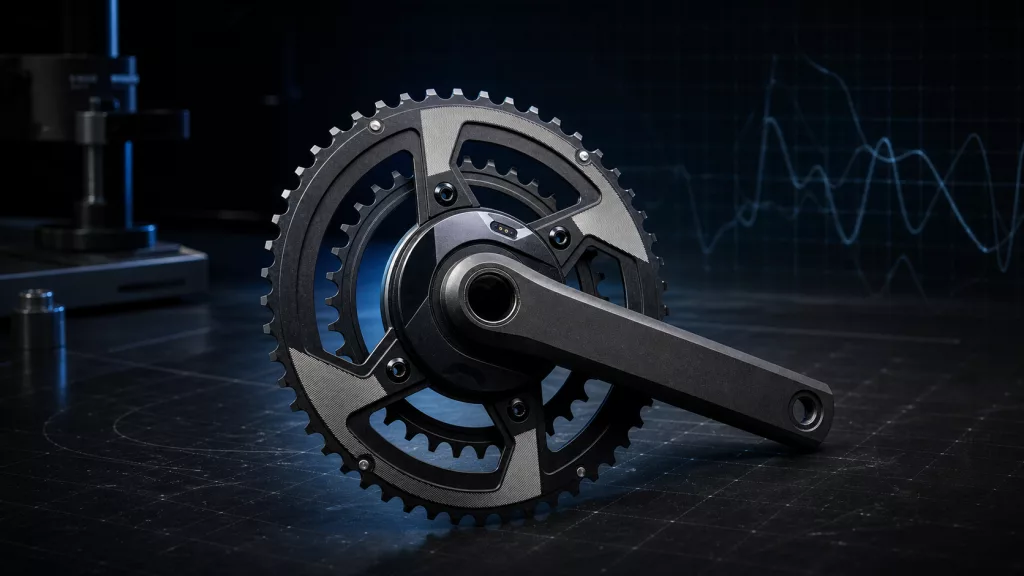
Reliable power meter accuracy testing uses several complementary methods. No single comparison ride is enough. A peer-reviewed study of 54 cycling power meters found that measurement trueness varied considerably even when precision was generally high, reinforcing the need for first-principles reference testing.
1. Establish a Suitable Reference
The reference system must have known, documented uncertainty and should be more accurate than the device under test. Depending on the test, this may be a calibrated torque fixture, a dynamometer or another laboratory system that independently determines mechanical power.
Comparing one consumer power meter with another can reveal disagreement, but it cannot prove which device is correct. A defensible test records the calibration status and uncertainty of the reference equipment.
2. Verify Zero Offset and Static Torque Response
A zero-offset procedure removes the unloaded sensor signal, similar to taring a scale. Many bike computers call this “calibration,” although it is not always a full calibration of the measurement slope.
A static test applies a known torque, often using a certified mass at a measured lever length. This can verify zero stability, strain-gauge response and scale factor. It is useful for finding a constant high or low bias, but it does not validate cadence measurement, dynamic filtering or performance during accelerations.
3. Run Dynamic Power and Cadence Tests
Dynamic testing should cover a matrix rather than one steady-state point. A practical protocol includes:
- low, moderate and high power;
- low, normal and high cadence;
- seated and standing pedalling;
- rapid changes in torque and cadence;
- short sprint efforts and longer steady intervals;
- different pedalling styles and, where relevant, non-round chainrings.
The test should compare both interval averages and the full time series. A device may show an acceptable average while still producing spikes, dropouts, excessive delay or cadence-dependent bias.
4. Test Temperature and Environmental Stability
Strain gauges, bonding materials and mechanical structures respond to temperature. A robust evaluation therefore checks cold starts, warm conditions and temperature transitions rather than testing only in a stable laboratory.
Environmental validation may also include water resistance, vibration, shock, contamination and long-duration fatigue. These tests do not directly calculate the ±1% value, but they show whether accuracy and reliability can be maintained in real use.
5. Validate the Complete Data System
Power measurement does not end at the sensor. Testers should also assess:
- cadence detection;
- transmission stability and packet loss;
- timestamp alignment and latency;
- firmware and filtering behaviour;
- battery condition;
- bike-computer recording settings;
- data-processing differences between analysis platforms.
When devices are compared, their data streams must be aligned in time. Otherwise, a short delay during a sprint can appear to be a large accuracy error.
6. Check Unit-to-Unit Production Variation
A prototype that meets its target does not prove that mass-produced units will do the same. Bicycle brands should evaluate multiple samples across production lots and review the distribution of zero offset, scale factor, temperature response and dynamic error.
End-of-line calibration, test-equipment control, serial-number traceability and clear acceptance limits are essential. This production perspective is one of the most important differences between a product review and a supplier qualification program.
A Practical Accuracy Check for Riders
A field comparison cannot replace laboratory calibration, but it can identify obvious problems:
- Confirm correct installation, crank length, firmware and battery condition.
- Warm up the equipment as instructed by each manufacturer.
- Perform the correct zero-offset procedure on each device.
- Use a clean, well-maintained drivetrain when comparing with a trainer.
- Record both devices on separate head units at the same sampling rate.
- Include steady efforts, cadence changes and several short accelerations.
- Align the files by time and compare intervals as well as the complete traces.
- Look for stable bias, drift, spikes, dropouts and cadence-dependent differences.
Do not adjust a power meter simply to make it match another device unless the manufacturer provides a validated procedure. If the difference is large or unstable, repeat the setup checks and contact technical support.
What Bicycle Brands Should Ask a Power Meter Supplier
For an OBM pre-installation or ODM program, the headline accuracy number is only the beginning. Product, engineering and quality teams should ask:
- What power, cadence and temperature ranges are covered by the accuracy claim?
- What reference equipment is used, and how is it calibrated?
- Are static torque and dynamic pedalling tests both included?
- How are transient efforts, temperature changes and data dropouts evaluated?
- What are the unit-level and batch-level acceptance criteria?
- Is every production unit calibrated or tested at the end of the line?
- Can test results be traced to a serial number and production lot?
- How are firmware, installation and complete-bike compatibility controlled?
- What sample-validation and after-sales support are available?
These questions convert “±1%” from a marketing statement into an engineering requirement.
What ±1% Should Mean in a Product Decision
The best interpretation is simple: ±1% is a defined performance tolerance against a suitable reference under stated conditions. It is not a promise that every device in the cycling ecosystem will display the same number.
For riders, stable and repeatable data is essential for tracking progress. For bicycle brands, accuracy must also be reproducible across units and production lots. That requires controlled calibration, dynamic validation, environmental testing and traceable quality processes.
Magene Enterprise provides OBM pre-installation and ODM services for cycling technologies, including power meter solutions. Our product FAQ specifies ±1% power meter accuracy. Brands evaluating a spider power meter or a broader complete-bike integration can contact our team to review specifications, compatibility and sample-validation requirements for their platform.
Explore Magene Enterprise Power Meter Solutions
Discuss Your Power Meter Project
FAQ
Is a ±1% power meter accurate enough?
For most training and performance applications, ±1% is a strong specification when it is supported by repeatable measurements and clearly defined test conditions. Installation, calibration and sensor location still affect comparisons.
Does ±1% mean a 300 W reading is exact?
No. Against a 300 W reference, a ±1% tolerance allows a reading from 297 W to 303 W under the specified conditions.
Why does my power meter read higher than my smart trainer?
They measure at different points. A pedal, crank or spider system measures before some drivetrain losses, while a trainer measures after power has passed through the chain and other components.
Is zero offset the same as calibration?
Not always. Zero offset removes the unloaded sensor signal. Full calibration may also verify or adjust the relationship between applied torque and the sensor output.
Is a spider power meter more accurate than a crank power meter?
Sensor location alone does not determine accuracy. A spider power meter measures combined power near the chainrings, while many crank-arm systems estimate total power from one side. Test method, compensation, installation and production quality are all important.
How often should a power meter be calibrated?
Follow the manufacturer’s instructions. Some devices require a manual zero before riding or after installation; others provide automatic zero-offset functions. A full static calibration should only be performed using an approved procedure.