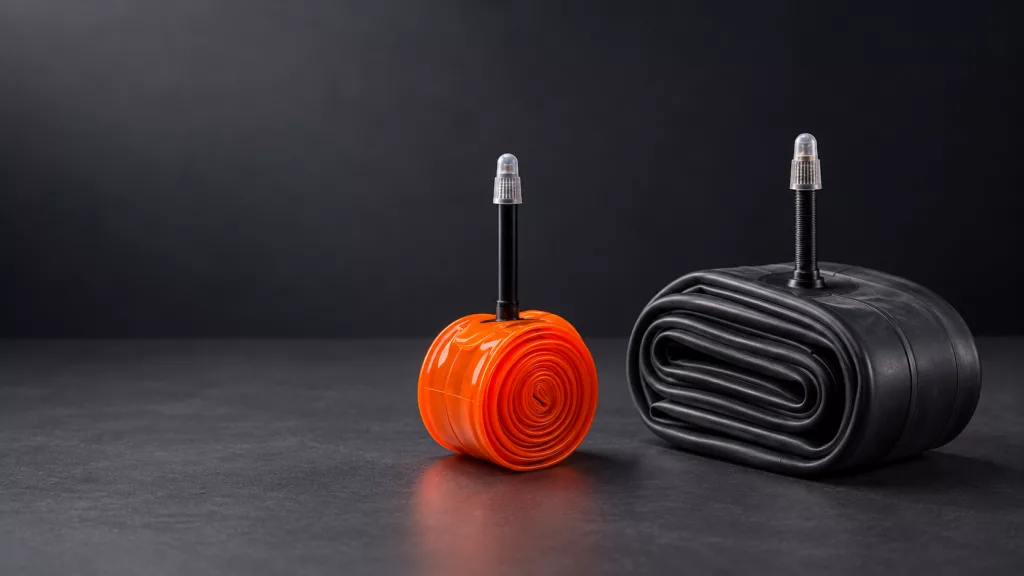
Choosing between TPU and butyl inner tubes starts with your product brief. TPU can suit a lightweight upgrade or compact spare. Butyl remains worth considering when target price and familiar repairs take priority. For a bicycle brand, the decision also depends on proven performance, product limits and support costs.
The 30-second comparison
| Factor | TPU inner tubes | Butyl inner tubes |
|---|---|---|
| Weight and packing | Can offer lower weight and a smaller packed size; compare equivalent sizes | Assess the matching model as your baseline |
| Rolling resistance | Varies by model: some outperform butyl, others do not | Light butyl can outperform some TPU models |
| Air retention | Verify pressure loss under defined conditions | Test under the same conditions for a fair comparison |
| Repair | Use the repair materials approved for the specific tube | Familiar repair methods can simplify support; confirm product instructions |
| Total cost | Include validation, approved patches and distributor guidance | Check actual quotations and support costs rather than assuming a fixed saving |
| Use limits | Confirm tyre size, valve fit and brake compatibility by model | Confirm the selected model’s fit and installation requirements |
For brands, TPU is worth evaluating when verified weight or packing benefits support the product’s positioning. Butyl may remain the better fit for a price-led replacement range. The sections below explain how to check those benefits before approving samples or placing volume orders.
Start with the use
TPU stands for thermoplastic polyurethane; butyl is a synthetic rubber. Both materials hold air inside a tyre. Their names alone do not tell you how a finished tube will perform.
Brands must first clarify whether the inner tube is intended for use in complete vehicles, sold as an upgrade part, or packaged as a spare inner tube. An upgrade needs specifications and evidence are needed to support its advertised benefits. If sold as a spare inner tube, appropriate packaging dimensions and clear repair instructions are required.
That brief sets the comparison baseline. Additionally, before comparing the two materials, it is necessary to select TPU and butyl samples with the same rim diameter and tire width.
Match the specifications
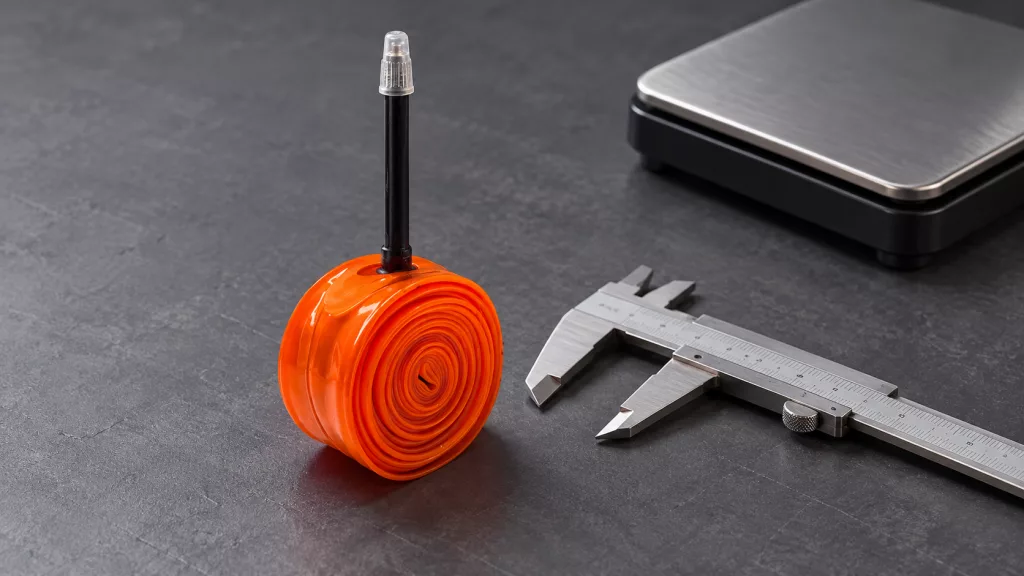
A road tube and a wide MTB tube are not a fair weight comparison. Record the intended tyre size, valve configuration and rim fit alongside each sample’s weight.
For example, Magene Enterprise’s TPU inner tube range lists these gravel and MTB configurations:
| Specification | Gravel TPU | MTB TPU |
|---|---|---|
| Wheel size | 700C | 27.5 / 29 in |
| Tyre width | 32-48C | 1.8-2.5 in |
| Listed weight | 47 g | 63 / 66 g |
| Valve length | 60 / 75 mm | 45 mm |
Obtain matching butyl samples before calculating weight savings. Weigh several samples and agree on acceptable variation. This establishes the weight comparison, but a lighter tube does not automatically roll faster.
Check the rolling data
Rolling resistance measures the energy lost as the wheel rolls. Brands should compare the performance of their finished wheels on their own; not all TPU inner tubes outperform butyl rubber inner tubes.
Bicycle Rolling Resistance’s independent test, updated in January 2026, reports these results:
| Tested model | Material | Measured weight | Rolling resistance at 80 psi / 5.5 bar |
|---|---|---|---|
| Pirelli P Zero SmarTube RS | TPU | 35 g | 10.9 W |
| Pirelli P Zero SmarTube | TPU | 35 g | 12.1 W |
| Continental Race 28 Light | Butyl | 75 g | 11.6 W |
| Continental Race 28 | Butyl | 102 g | 12.6 W |
The results average three 25-622 road tyres. Testing used a 42.5 kg wheel load at 28.8 km/h, with a 17.8 mm internal-width rim. Temperatures were 21.5-22.5°C.
Both Pirelli tubes weighed 35 g, yet their rolling results differed. Light butyl also rolled faster than the standard SmarTube. The watt figures describe tyre-and-tube combinations, not the tube alone.
These test results do not prove performance or equivalent advantages on gravel roads or with mountain bike tires. Therefore, please use them as a reference for developing test methods.
Test how tubes fail
Rolling tests address efficiency. They do not establish puncture resistance, air retention or service life, so reliability needs its own assessment.
When testing reliability, distinguish between punctures caused by sharp objects and blowouts resulting from impact or compression. Also, check seams and valve stems for air leaks to prevent other factors from influencing test results.
When assessing a TPU inner tube supplier, request the method behind each result. Air retention records should state starting pressure, duration and temperature. Ask for sample counts and batch references, including failures.
Then use road trials to check the intended tyre and rim setup. Record pressure, load, distance and any problems. A leak-free trial describes those samples over that period; it does not prove a zero failure rate.
Together, these checks provide a basis for acceptance criteria. They should also identify restrictions that need to appear in the product specification.
Set clear limits
Brake compatibility is one such restriction. Continental prohibits rim-brake use for ContiTPU, while Schwalbe approves Aerothan tubes for rim brakes. Approval for one model does not apply to another.
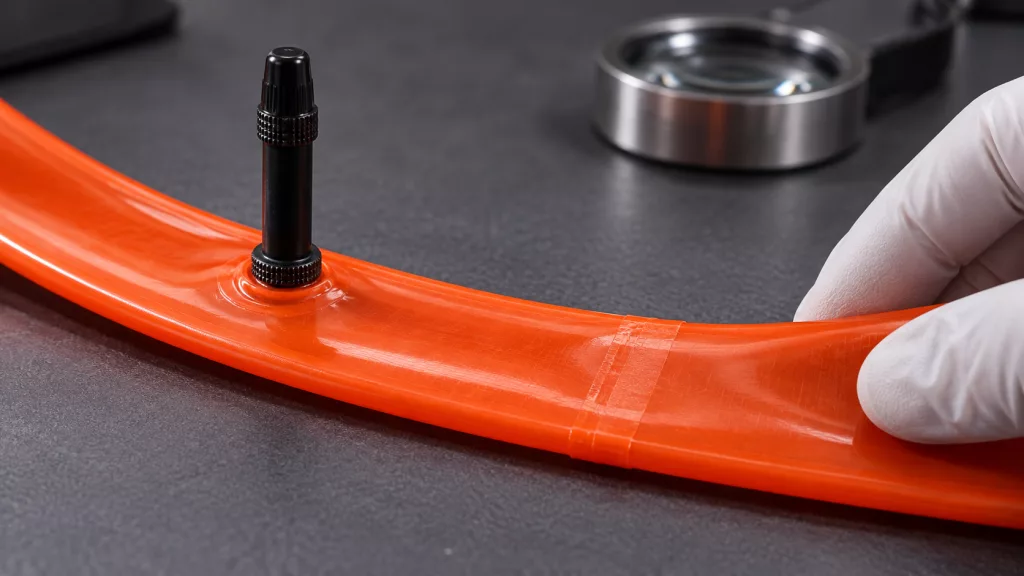
Repair methods also need product-specific instructions. Tubolito specifies its Tubo-Patch Kit and states that butyl repair kits are incompatible with its tubes. Confirm the approved method for your selected tube and test the supplied patches.
Put these limits into the purchasing specification before volume orders. Include size coverage, valve details, weight tolerances and agreed test criteria. Keep packaging and installation guidance consistent with that approved specification.
This turns sample findings into requirements the supplier can follow. It also reveals costs that a unit quote may leave out.
Compare the full cost
Include validation, inspection, packaging and repair materials in the cost comparison. Agree on lead times, order quantities and quality-claim handling using actual supplier quotations.
For US and European distribution, check whether local partners can obtain replacement patches. Plan suitable language versions of the instructions, clear size labels and pressure units. These support needs remain even if the purchase price is attractive.
Once all cost planning is finalized, selections must be made by product line. TPU may be suitable for upgrade or spare-part solutions where proven weight and packaging advantages are key. Butyl rubber, on the other hand, may be better suited for product lines where the focus is on target pricing and familiar repair methods.
A mixed portfolio can serve both. There is no need to replace every butyl tube to introduce a credible TPU range.
Choose for your range
Choose the material whose measured benefits fit the product’s role and price. Then confirm that the supplier can deliver the approved specification and support it after launch.
For a TPU inner tube ODM project, discuss your target sizes, markets and sample requirements with Magene Enterprise. Configuration and customisation should follow a feasibility review.
FAQs
Are TPU inner tubes more puncture resistant?
A material label does not establish the answer. Compare specific models using the same puncture method and keep pinch-flat results separate. For packaging claims, identify the tested baseline and conditions rather than claiming all TPU tubes are more durable.
Can TPU inner tubes be repaired?
Some can, using the repair materials approved for that product. Confirm the patch type and procedure with the supplier. For brands, this also means checking kit availability and giving distributors the same instructions as end users.
Do TPU tubes hold air better than butyl?
Compare measured pressure loss under the same conditions. Record temperature and test duration before drawing conclusions. Neither a TPU label nor a short leak check establishes better air retention across all models.
What should a brand request before ordering?
Request identified samples, batch references, test methods and recorded results. Agree on acceptance limits and change notification before placing volume orders. Include repair support and installation guidance in the review, not only dimensions and weight.